Mini-leagues: concepts
Mini-leagues allow clubs to organize regular internal competitions among their members. This page presents the key concepts to understand how they work.
Video: how a mini-league works
Hierarchy
graph TD
    C["🏢 Club"] --> ML1["Mini-league A<br/><small>e.g.: Tuesday League</small>"]
    C --> ML2["Mini-league B<br/><small>e.g.: Thursday League</small>"]
    ML1 --> S1["Session 1<br/><small>1-31 January</small>"]
    ML1 --> S2["Session 2<br/><small>1-28 February</small>"]
    ML1 --> S3["..."]
    S1 --> D1["Division 1<br/><small>(top players)</small>"]
    S1 --> D2["Division 2<br/><small>(intermediate)</small>"]
    S1 --> D3["Division 3<br/><small>(beginners)</small>"]
    D1 --> P1["Pool A<br/>4 players"]
    D1 --> P2["Pool B<br/>4 players"]
    D2 --> P3["Pool C<br/>4 players"]
    D2 --> P4["Pool D<br/>4 players"]
D3 --> P5["Pool E<br/>4 players"]- A club can manage several mini-leagues in parallel
- Each mini-league runs in successive time sessions (one session after another)
- Each session is divided into divisions (skill levels)
- Each division contains one or more pools (groups of players)
- Within a pool, each player faces all others (round-robin)
Session flow
graph LR
    A["Session start"] --> B["Matches in progress<br/><small>round-robin within<br/>each pool</small>"]
    B --> C["End reminder<br/><small>notification to<br/>players</small>"]
    C --> D["Session end"]
    D --> E["Redistribution<br/><small>the following night</small>"]
    E --> F["Review period<br/><small>new session closed,<br/>checks by the manager</small>"]
F --> G["New session<br/>opens"]- The session starts with players distributed into pools
- During the session period, players play their matches
- A few days before the end (5 by default), players who still have matches to play get a reminder
- The night after the end, if automatic renewal is enabled, MySquash redistributes the players and creates the new session, still closed
- During the review period (1 day by default), the manager checks the new session, places the players who asked to join the mini-league (Integration requests) and adjusts the pools if needed
- The new session then opens automatically and players are notified. The manager can also open it earlier.
The review period is part of the new session
The review period is taken out of the duration of the new session. If the manager saves the new session as a draft during the review, it no longer opens automatically.
Divisions and pools
Divisions represent skill levels. Division 1 groups the top players, Division 2 the intermediate players, etc.
When a division has too many players for a single pool, it is split into multiple pools. Pools within the same division are parallel groups of the same level: they only serve to limit the size of round-robin groups.
Promotion and relegation
Promotion and relegation occur between divisions. From one session to the next, the pools of a division are rebuilt: a player who stays in their division can change pool.
Redistribution between sessions
At the end of each session, players are redistributed according to their results. Each pool has a configurable number of promotion and relegation slots (1 by default), defined in the mini-league configuration. Division 1 has no promotion and the last division no relegation.
Example
A mini-league with two divisions of two pools. At the end of the session, the top player of each pool in Division 2 moves up and the last player of each pool in Division 1 moves down:
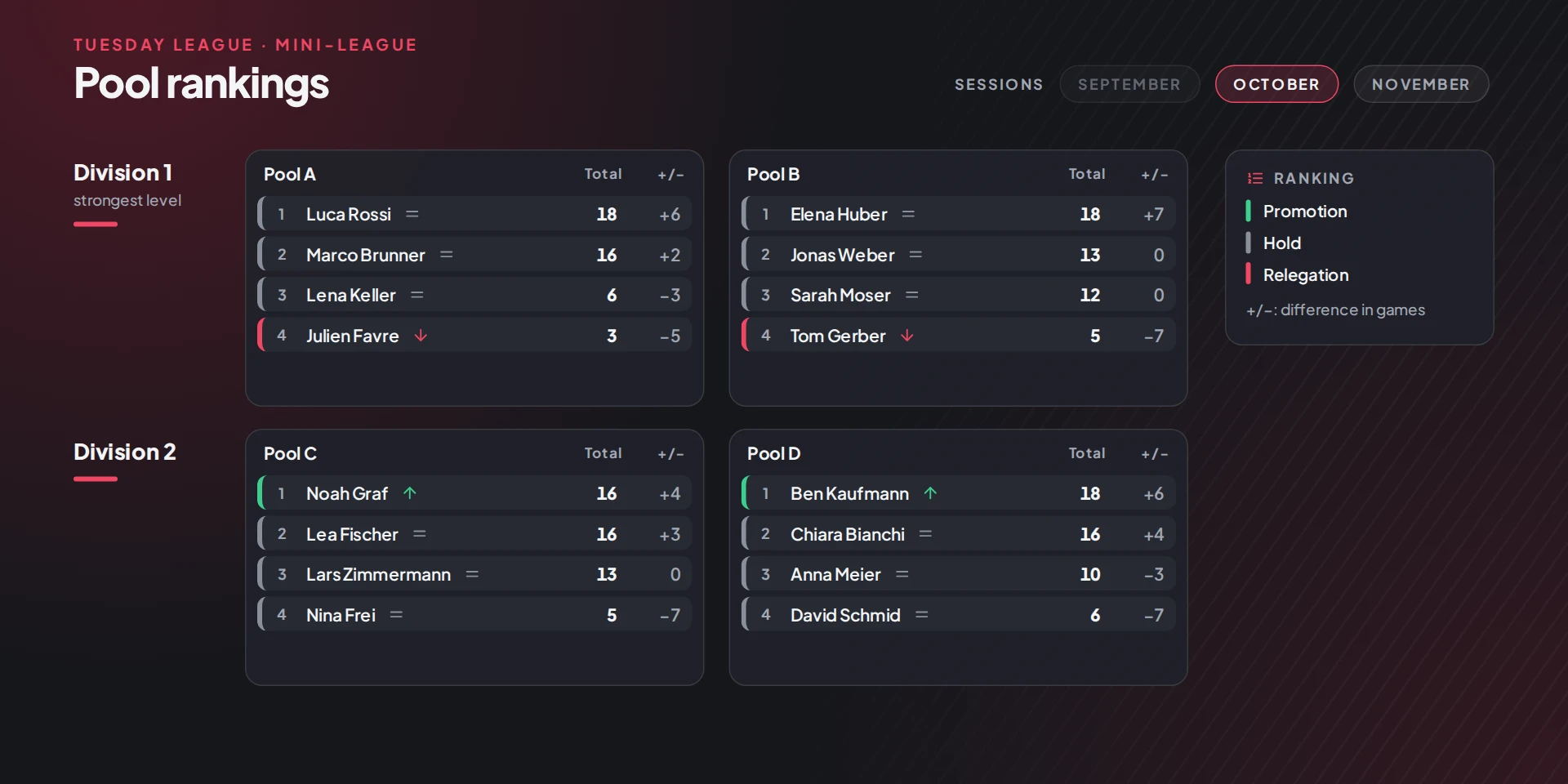
When players have the same total, the ranking filters break the tie: in Pool C, Noah Graf finishes ahead of Lea Fischer on the difference in games.
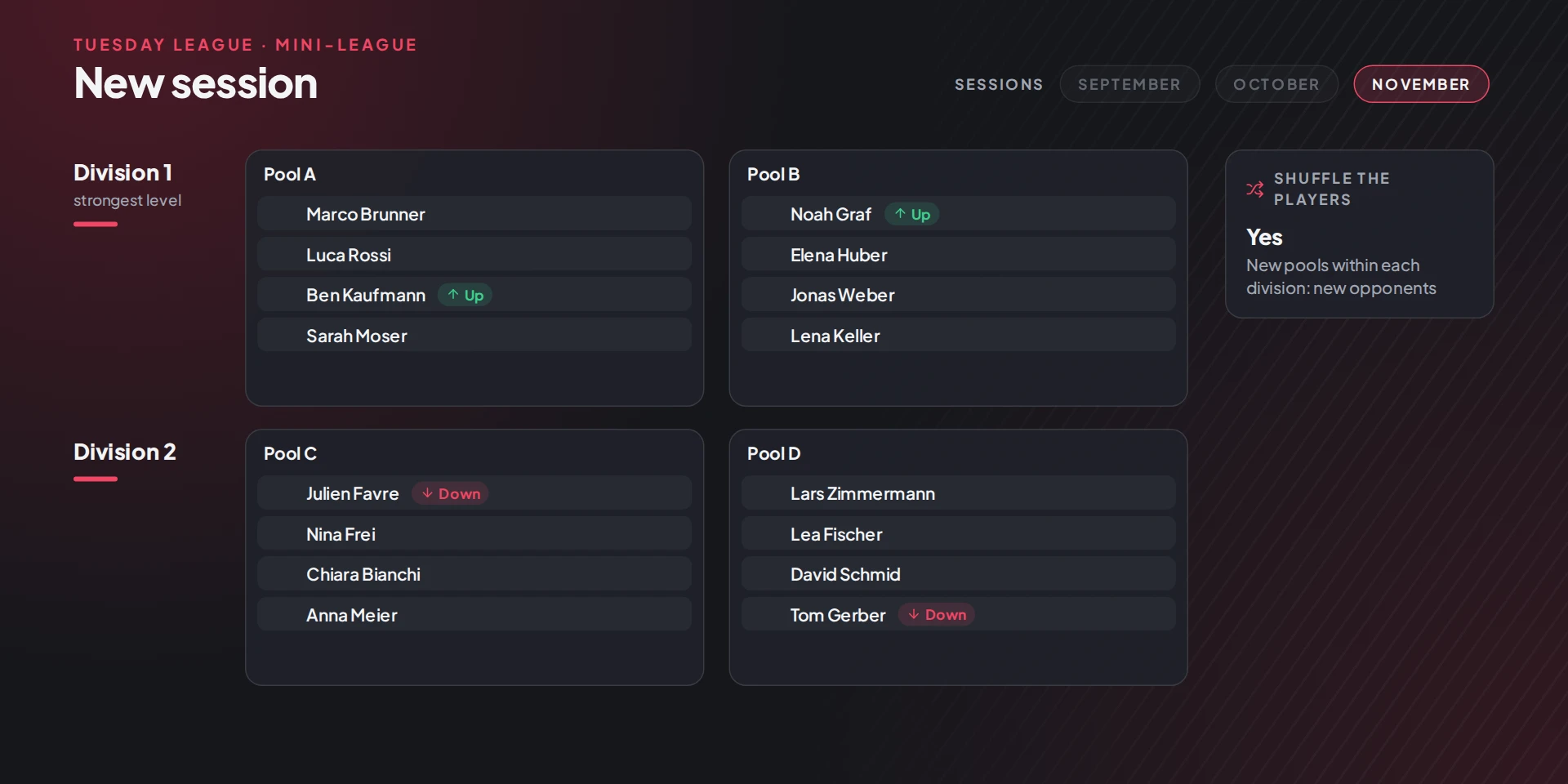
In the new session, each player is placed in their new division, and the players of each division are shuffled across its pools (Shuffle players parameter, see Mini-league parameters):
Balance promotions and relegations
MySquash does not move players one by one. It ranks all the players in a single list (for each division: its promoted players, the players who stay, then the players relegated from the division above) and fills the divisions in that order, each up to its number of places. The top player of each pool therefore only moves up if the division above frees as many places. If Division 1 has a single pool with one relegation and Division 2 two pools with one promotion each, only the better of the two pool winners moves up. Plan as many relegations in each division as promotions in the division below.
Matches and points
Within each pool, matches are played in round-robin format: each player faces all others. Results are converted into points according to a configurable table.
The pool ranking is then calculated using configurable ranking filters (tiebreak criteria) ordered by priority.
Parameters
Mini-leagues are configurable at two levels:
- Club parameters: default values and global parameters, shared by all mini-leagues in the club. See Mini-league parameters.
- Session parameters: each mini-league can adjust its own parameters (duration, scoring system, point scale, etc.)